
Tree work in Berkeley County
Tree Removal in Martinsburg, WV
The short answer
Tree removal in Martinsburg usually means taking a tree apart from the top down, not dropping it whole: the yards are close together, the houses sit near the old trees, and Potomac Edison's service wires run through many crowns. One independent local contractor looks at the tree, decides how it can come down safely, names a price and does the work if you agree.
Inside Martinsburg, a tree on a street, park or other public place can't be removed, cut or disturbed without a Shade Tree Commission permit, and the city's permit wording is broad enough that city residents should check with the city before removing a tree near the street or right-of-way (City Code §150.08(e) and §150.09(b), checked Nov 28, 2026). Out in the county, no permit was found for removing an ordinary tree on a house lot. The things that most often change a removal here are dead ash, wires to the house, soft limestone ground, and what you want done with the wood and brush.
How does a big tree near a house come down?
Most removals beside a house in Martinsburg, Spring Mills or Inwood follow the same order. The crew first looks at the lean, the dead limbs, what lies under the crown and where the truck can park. A climber ties in high in the tree, or a bucket truck sets its outriggers on pads. The crew cuts the side limbs first, lowering heavy ones on a rope through a block so they don't swing into the roof or fence. Then the top comes out, then the trunk in sections short enough to lower or drop into open lawn. The brush goes through the chipper as it comes down, and the trunk wood is cut to length.
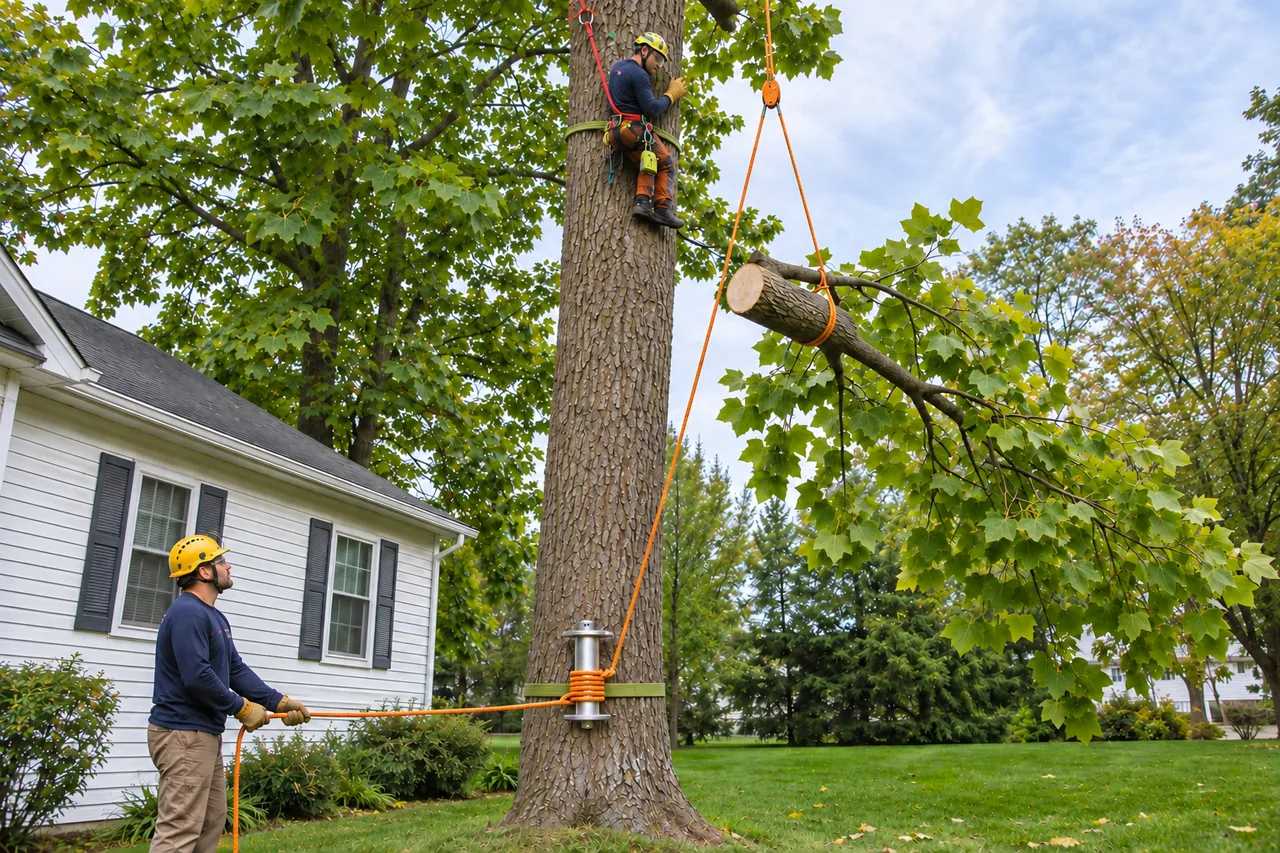
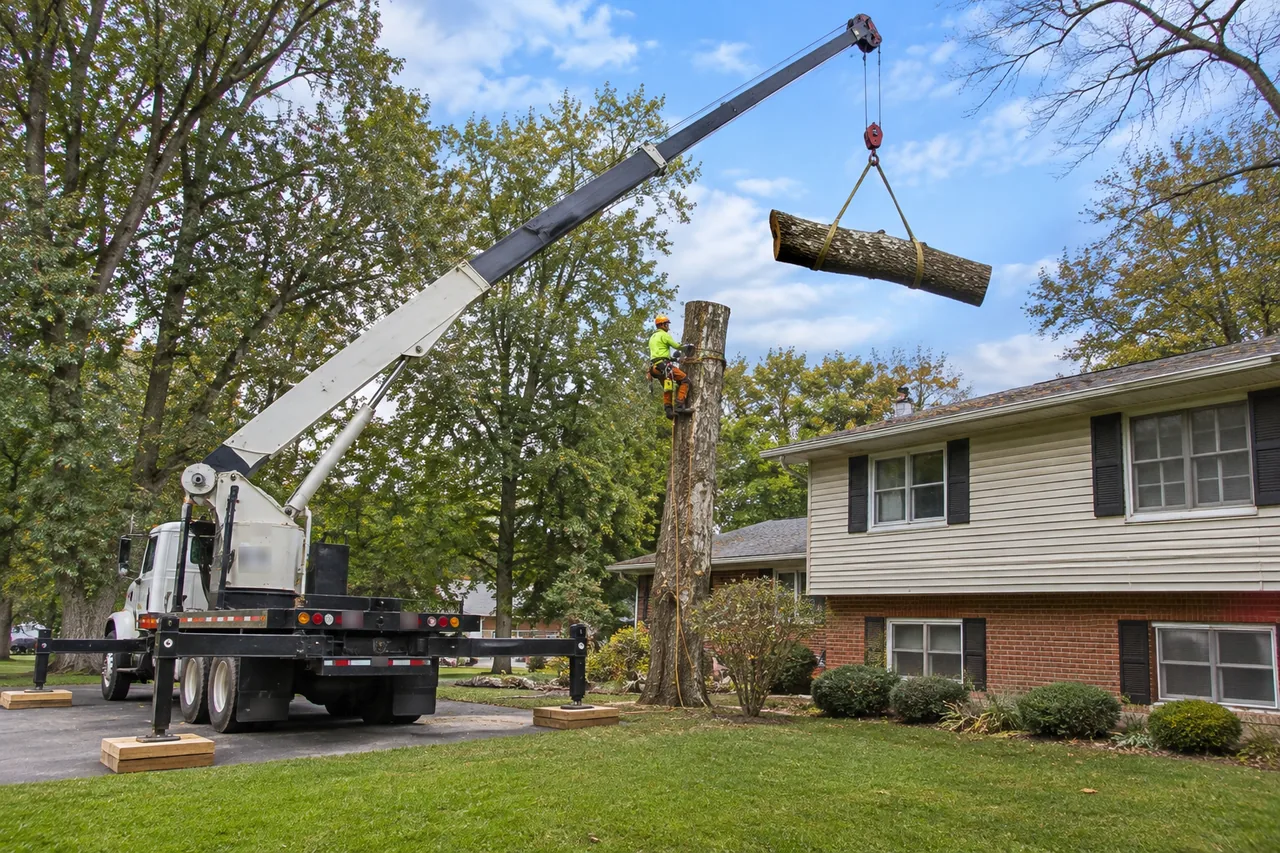
Felling the whole tree in one piece works only where there is a clear landing zone longer than the tree is tall, which is more likely on a few acres off Back Creek or toward Gerrardstown than in town. A crane makes sense when the tree is dead and brittle, when it hangs over the house, or when the crew can't climb it safely. HomeGuide's national figures put crane work at $500 to $2,500 a day on top of the removal (HomeGuide, undated, checked Nov 28, 2026).
Which trees get removed most around Martinsburg?
No public list of local removals exists, so the trees below come from what grows here and what is dying here, with their sources.
- Ash. The emerald ash borer was found in West Virginia in October 2007, in Fayette County (emeraldashborer.info), and in 2009 the state agriculture department confirmed it in a southern Morgan County subdivision, Berkeley County's neighbor to the west (Shepherdstown Chronicle, Sept. 18, 2009). An ash with a thin top, bark stripped pale by woodpeckers and sprouts on the trunk is likely already dying.
- Oaks. The West Virginia Department of Agriculture took many reports of oak decline in the Eastern Panhandle in 2025. Site visits often found red oaks with bacterial leaf scorch, or white and red oaks on very poor sites near the end of their lives (West Virginia Forest Health Highlights 2025, checked Nov 28, 2026).
- Hemlock. Hemlock woolly adelgid is present in all 55 counties of the state, Berkeley included (same report). Penn State Extension says the insect can kill an eastern hemlock in as few as four years.
- Tree of heaven and Callery pear. Both are threat level 1, "highly invasive," on the state's invasive plant list (WVDNR, April 2025). Tree of heaven is also the spotted lanternfly's favorite host. See lanternfly and tree of heaven.
- Tulip poplar, silver maple, black walnut, white pine. Big, fast or heavy yard trees. Black walnut is one of the native hardwoods USDA lists on the valley's Hagerstown limestone soil (USDA).
Why is a dead ash harder to take down?
Dead ash dries out and loses strength. A climber leans on, ties into and cuts against wood that could snap, so a tree that has been dead for a couple of seasons is often taken down from a bucket truck or with a crane instead of climbed. That is why the price on a dead ash can be well above what the same tree would have cost three years earlier. Maryland's forest service lists the signs to look for: canopy thinning from the top and sides, D-shaped exit holes, S-shaped tunnels under loose bark, vertical bark splits and sprouts at the base (Maryland DNR). If you see these on an ash over the house or the driveway, call before the next storm season, not after it.
What if the tree is near the wire to the house?
Potomac Edison serves Berkeley County. Its parent, FirstEnergy, says that if you want a tree removed between the utility pole and your home, it "will need to disconnect the service. Service fees may apply," and that "the homeowner will be responsible for the actual tree removal" (FirstEnergy, Report a Tree Problem, checked Nov 28, 2026). FirstEnergy offers a temporary disconnection for tree work on request, for a nominal fee, and asks for several business days' notice (FirstEnergy, checked Nov 28, 2026). Build that time into the plan. A tree tangled in the main lines along the road is the utility's to clear first. The power line page has the details.
Does the limestone under the yard matter?
It can. Berkeley County sits partly on carbonate rock "upon which karst topography has developed," the USGS says (USGS WRI 93-4073). Sinkholes form there, and the county keeps new construction at least 50 feet from any that hasn't been repaired (Subdivision and Land Development Ordinance, Section 404.5, amended January 2025). A crane or a loaded log truck puts a lot of weight on a few square feet. If you know of a soft spot, a sunken ring in the lawn or an old sinkhole that was filled, tell the contractor before the truck backs in. More on the karst page.
What happens to the wood and brush?
You choose, and the choice changes the price. The usual options:
- Chipped and hauled away. The crew takes everything. This is the most common choice in subdivisions.
- Chips left behind. Useful as mulch on beds and paths.
- Firewood rounds left stacked. Cut to the length your stove or fire pit takes.
- Hauled to a county site yourself. The Grapevine Road Recycling Center in Martinsburg and the South Berkeley Recycling Center in Inwood take brush, Tuesday to Saturday, 9 a.m. to 5 p.m., in pieces under 10 feet long and under 6 inches thick: $10 a pickup load, $20 for larger loads (Berkeley County Solid Waste Authority, checked Nov 28, 2026).
- Burned. Inside the city only in two short windows a year, and never stumps or limbs over 8 inches thick. Outside the city, only at night in fire season. See burning brush.
Do I need a permit to remove a tree?
It depends on which side of the city line the tree stands. Inside Martinsburg, City Code §150.08(e) says no one may "remove, cut above the ground, or disturb any tree on any street, park, or other public place without first filing an application and procuring a permit from the Shade Tree Commission." The chapter's general permit sentence, §150.09(b), is broadly worded, and the code doesn't settle how it applies to a private yard, so check with the City of Martinsburg before removing a tree near the street or right-of-way (Chapter 150, checked Nov 28, 2026). Outside city limits, no county permit turned up for an ordinary tree on an existing house lot. Berkeley County's subdivision ordinance defines "clearing" as cutting or removing trees "without land disturbance," while its "land disturbance" definition includes removing stumps and root systems. That matters only when a project grows into grading or building: the county asks for a site plan before disturbing more than 5,000 square feet (Berkeley County Planning, checked Nov 28, 2026). Work inside a state road's right-of-way is a West Virginia Division of Highways matter; its Form MM-109 is the right-of-way entry permit application. All of it is on the tree rules page.
What does a removal cost?
| Tree | National range |
|---|---|
| Under 30 feet | $150 to $500 |
| 30 to 60 feet | $300 to $1,000 |
| 60 to 80 feet tall | $650 to $2,000 |
| Over 80 feet | $1,200 to $2,700 |
| Oak | $250 to $2,500 |
| Maple | $600 to $2,800 |
| Ash | $800 to $1,900 |
| Poplar | $1,100 to $3,000 |
| Pine | $200 to $1,600 |
These are not Martinsburg prices. The contractor's written price after seeing your tree is the one that counts. More tables on the price page.
Common questions
Can a tree come down in winter?
Yes, and bare limbs make it easier to see what's dead. Frozen ground also carries a truck better than a wet spring lawn.
My neighbor's tree is leaning toward my house. What can I do?
Start by talking to the neighbor, with the tree in plain view. Photos and dated notes of the lean, the dead limbs or the cracks help later if anyone calls a homeowner's insurance company.
Should the stump be ground the same day?
It can be, after the 811 notice period. See stump grinding.
Have a tree like this?
One independent local contractor who works the Martinsburg area can come out, look it over and put a price on it.
Call (681) 248-5434 Or write it up on the request form