
The ground
Karst, Sinkholes and Trees in Martinsburg, WV
The short answer
Much of the ground around Martinsburg is karst: limestone and dolomite bedrock that dissolves slowly, leaving sinkholes, springs and rock ledges close to the surface. That changes tree work in three ways: where a heavy truck or crane can safely set up, how deep a stump grinder can go, and what a sudden hollow near a tree might mean. One independent local contractor who works the Martinsburg area looks at the ground as well as the tree before the job.
The U.S. Geological Survey says Berkeley County is underlain by carbonate rocks, "upon which karst topography has developed," and by noncarbonate rocks (USGS WRI 93-4073, 1995, checked Nov 28, 2026).
What two kinds of ground does the county have?
Berkeley County lies in the Great Valley, between North Mountain to the west and the Opequon Creek and Potomac River country to the east. Two broad kinds of bedrock lie under it:
- Carbonate rock (limestone and dolomite). "Sinkholes and other karst features are common in the carbonate rocks of the Great Valley," USGS geologists wrote in a 2022 map of the Inwood and White Hall quadrangles (USGS SIM 3487).
- Shale. The same USGS map describes the Martinsburg Formation, named for the city by Geiger and Keith in 1891 (USGS Geolex), as "shale, graywacke, and calcareous shale," not a carbonate rock.
USGS also found that the county's biggest springs, putting out more than 2,000 gallons a minute, are "typically on or near faults or the limestone-shale contacts."
What soils grow the trees?
USDA's official soil series descriptions give a picture of what lies under a lawn. All were checked Nov 28, 2026.
| Soil series | Formed in | Depth to bedrock | Notes from USDA |
|---|---|---|---|
| Hagerstown | Hard gray limestone | 40 to 84 inches or more to hard limestone | Well drained; native vegetation "mixed hardwoods, including black walnut" |
| Swanpond | Limestone residuum | More than 60 inches | Very fine clay, moderately well drained, slow permeability; type location in Berkeley County; some urban development |
| Poorhouse | Limestone residuum with some colluvium | More than 60 inches | Somewhat poorly drained, slow permeability; type location in Berkeley County |
| Frankstown | Siliceous limestone with limy shale and siltstone | 40 to more than 60 inches | Forest of "oaks, hickory, ash, elm, maple, black walnut and flowering dogwood" |
| Berks | Shale, siltstone and fine sandstone | 20 to 40 inches | Well drained, slopes up to 80 percent, mixed hardwoods |
| Weikert | Acid shale, siltstone, fine sandstone | 10 to 20 inches | Shallow; mixed deciduous hardwoods |
Berks and Weikert are listed for West Virginia, but the county soil survey's map of where each series lies wasn't read for this guide. The contractor's eye on your actual lot settles which one you're on.
The clay limestone soils hold water and are slow to drain, so a lawn on Swanpond or Poorhouse soil can stay soft for days after rain. Trees on them root wide and fairly shallow above the dense clay. Shallow shale soils give roots even less depth, which is part of why trees on thin ground tip over with their root plates in high wind.
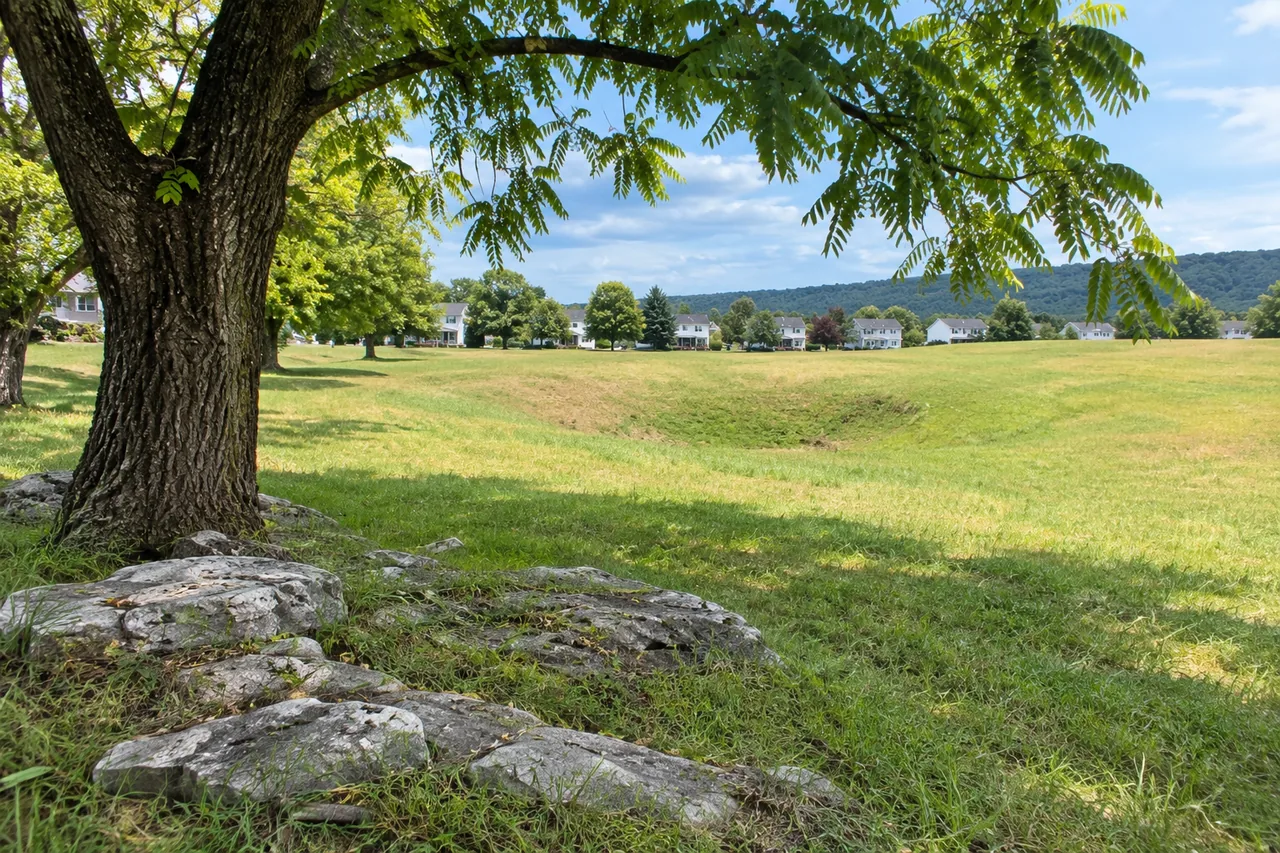
How do sinkholes affect tree work?
A sinkhole forms when soil washes down into a void in the rock below. USGS research in the northern Great Valley found sinkholes tend to cluster in zones of faulting and folding, usually on flat, raised ground under 5 degrees of slope, often near entrenched streams, and more where the water table swings up and down a lot (Doctor and others, USGS, 2008).
For tree work, that means:
- Heavy loads go on firm ground. A crane's outrigger or a loaded truck puts tons on a small pad. Crews spread that load on timber mats, and they want to know about any soft spot, filled sinkhole or sunken ring in the yard before they set up.
- Water goes where it went before. Stumps and roots in a hollow often mark a natural drain. Grinding them out and filling the low spot with packed soil can change where runoff goes.
- A new hole near a tree isn't always a rotted root. Ground chips from a stump settle as they rot. A hollow that keeps sinking after the first top-up, or one that opens suddenly after heavy rain, is worth reporting before anyone drives on it.
What does the county require near sinkholes?
Berkeley County's Subdivision and Land Development Ordinance, amended Jan. 30, 2025, Section 404.5, says "the location of all sinkholes shall be shown on the existing conditions scale drawing," that sinkholes found before construction "shall be either remediated or separated from construction by a minimum of 50' buffer," and that improvements within 100 feet of any sinkhole, repaired or not, "shall require a thorough subsurface investigation conducted by a qualified PG or PE" (county SALDO, checked Nov 28, 2026). The county's 2023 stormwater ordinance also limits infiltration practices in karst areas (Art. V.E.1(e)).
These rules apply to development plans, not to a homeowner taking down a tree. They do tell you that the county treats sinkholes as a real building hazard. If your plat shows a sinkhole buffer, keep heavy equipment out of it unless the contractor has checked the ground.
Does tree work affect wells and septic?
In karst, water moves quickly from the surface to the aquifer through cracks and sinkholes. Homes outside the city may have a private well and a septic field. Keep fuel cans, bar oil and herbicide mixing away from wellheads and sinkholes, and point out the well and the septic field before the crew drives on the lawn: a loaded truck over a drain field can crush the lines.
Common questions
My lawn has a sunken spot where an old tree used to be. Is it a sinkhole?
Often it's the old stump and roots rotting away. A hole that keeps growing, has steep sides or opens into a void is different. Keep people and vehicles off it, and ask the county planning office, (304) 264-1963, who looks at sinkholes on private land.
Can a stump grinder work on limestone ground?
Yes, but it may stop at rock. See stump grinding.
Do trees cause sinkholes?
No. Water dissolving the rock and washing soil downward does. A fallen tree's root plate can expose an opening that was already there.
Have a tree like this?
One independent local contractor who works the Martinsburg area can come out, look it over and put a price on it.
Call (681) 248-5434 Or write it up on the request form