
Rules
Burning Brush in Martinsburg, WV
The short answer
Inside Martinsburg city limits, yard brush may be burned only twice a year, March 15 to 30 and Nov. 1 to 15, between 5 and 8 p.m., after a call to Berkeley County Central Dispatch at (304) 263-1330. Out in the county, West Virginia law allows outdoor burning during the spring and fall fire seasons only between 5 p.m. and 7 a.m., inside a cleared strip at least 10 feet wide.
Stumps and limbs over 8 inches thick can't be burned in the city at all, and state air rules forbid burning trash, lumber and anything that isn't vegetation anywhere. The rules are quoted below, checked Nov 28, 2026.
What are Martinsburg's own burning rules?
The city's open burning ordinance (Ord. 2009-05, passed April 21, 2009, and Ord. 2011-06, passed Oct. 13, 2011) begins: "No outdoor burning shall be permitted in the City of Martinsburg," except as it allows (City of Martinsburg, checked Nov 28, 2026). For yard and garden waste, subsection (c)(2) sets these conditions:
| Rule | What the ordinance says |
|---|---|
| When | March 15 to March 30, and Nov. 1 to Nov. 15 |
| Call first | Berkeley County Central Dispatch, (304) 263-1330, each day you plan to burn |
| Hours | 5:00 to 8:00 p.m.; fires completely out by 8:00, with no smoldering or smoke |
| What may burn | "Only natural vegetation (thoroughly dried at least 10 days)" |
| What may not | Trash, roofing, rubber, plastic, asbestos, insulation, building materials including sawed lumber, stumps or limbs over 8 inches in diameter, other solid waste |
| Watching it | Supervised at all times, out before you leave it, 10 feet of clearance around it |
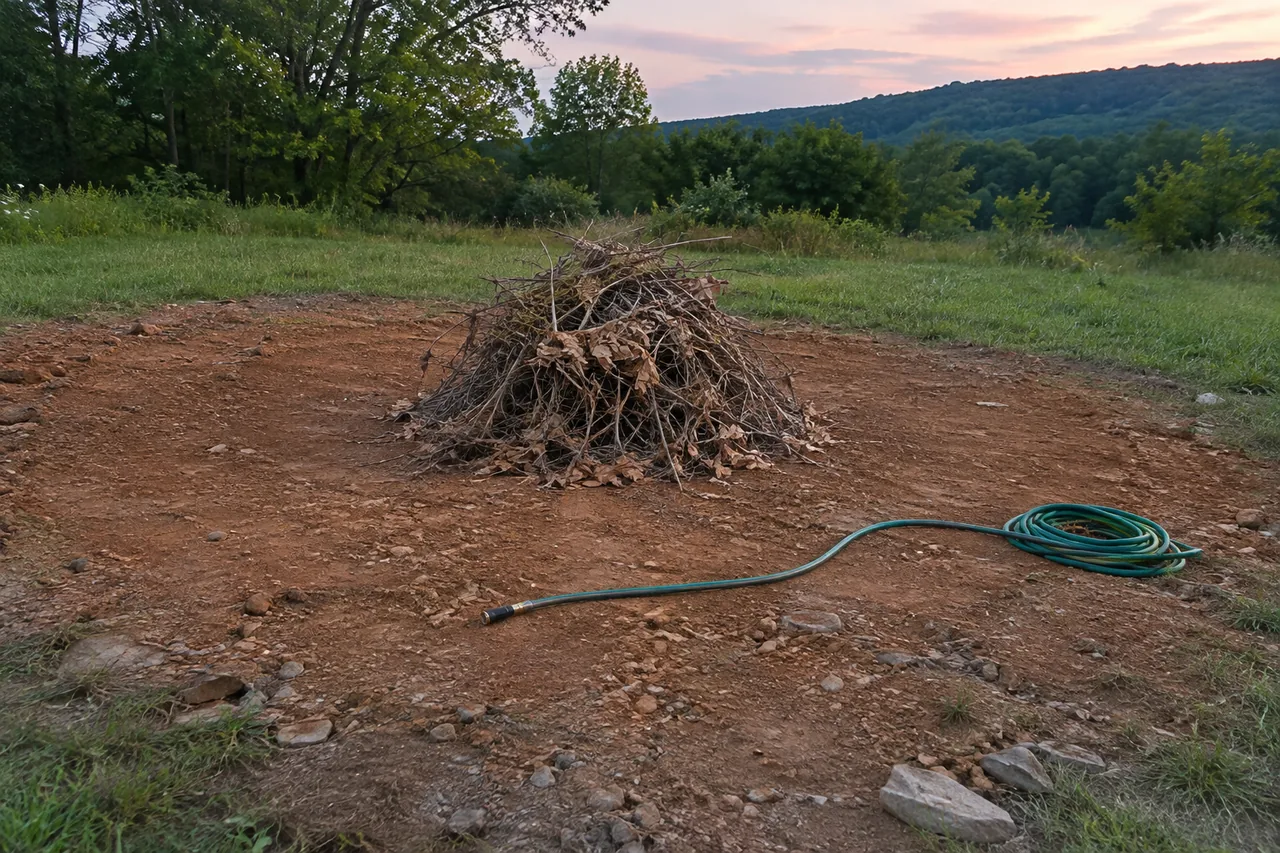
| Size and distance | No bigger than 4 feet across and 4 feet high, one pile at a time, at least 10 feet from any property line or structure |
| Nuisance | If smoke, odor or ash is reported to the Fire or Police Department as a public nuisance, the fire must be put out |
| Penalty | Misdemeanor, fines up to $500 per violation, plus court costs and fire suppression costs if the fire spreads |
Burning to clear land inside the city needs permits from both the West Virginia Division of Forestry and the Department of Environmental Protection's Division of Air Quality, five days' notice to the city Fire and Planning departments before applying, and is allowed only in November through March. Small cooking or warming fires in a container made for them are allowed any time. The Fire Chief can ban all outdoor burning when conditions are dangerous.
What that means for a tree job in town: a 4-by-4 pile only fits small brush. The trunk and the big limbs from a removal have to be chipped, hauled, split for firewood or taken to the county site.
What does West Virginia law say outside the city?
W. Va. Code §20-3-5 sets two forest fire seasons, March 1 through May 31 and Oct. 1 through Dec. 31. During them, burning is allowed "only between 5 p.m. and 7 a.m., at which time the fire must be extinguished" (§20-3-5, checked Nov 28, 2026). Anyone burning must clear burnable material around the fire, and "this safety strip shall in no event be less than 10 feet wide." A fire that escapes that strip and damages someone else's land is a misdemeanor.
- Snow: burning is allowed at any hour when the ground around the fire has "one inch or more of snow."
- Small fires: attended cooking, light or warmth fires are allowed with grass and debris cleared 10 feet around.
- Bans: a burning ban overrides these exemptions.
- Penalties: $100 to $1,000 per violation, plus a $200 civil penalty due within 60 days. The state's fall 2025 notice adds that whoever sets a fire that escapes pays for putting it out and for the damage (WV Emergency Management, Oct. 3, 2025).
Outside the two seasons, the state's hour limits don't apply, but the county guidance below and the air rules still do. A 2026 bill, SB 886, proposed letting owners run certain prescribed fires on private land without a burning permit; it was introduced Feb. 9, 2026 and sent to committee, and the season dates and hours in its text were unchanged (SB 886).
What does Berkeley County say?
The county's burn guidance tells residents to follow both the county and the City of Martinsburg rules. It says "only vegetative materials such as leaves, brush and yard clippings are permitted to be burnt," that "all fires must have a ring or safety strip" at least 10 feet wide, and that a fire "must be attended until completely extinguished." It repeats the state's no-burning hours of 7 a.m. to 5 p.m. during the spring and fall seasons, and says a Division of Forestry permit is needed to burn in prohibited periods for commercial burning (Berkeley County Outdoor Burn Ordinances, checked Nov 28, 2026). The county's own ordinance text wasn't on that page; it links to it separately.
What do the state air rules forbid?
West Virginia's open burning rule, 45CSR6, starts with a ban: "The open burning of refuse by any person is prohibited except for the following exceptions." The first exception, §45-6-3.1.1, is "vegetation grown on the premises of a home or farm," burned so that people's "health, safety, comfort and property" are protected (45CSR6-3, checked Nov 28, 2026). Burning land-clearing debris needs the DEP Secretary's approval and is allowed only when "there is no practical alternate method" of disposal (§45-6-3.1.3).
The DEP's own summary adds that land-clearing fires burn in daylight only, with no trunks, limbs or stumps over 8 inches across before splitting, and lists what can never be burned: household trash, burn barrels, lumber, roofing, carpet, plastic, tires, asbestos, paint and oil. Violations can bring fines of up to $10,000 a day (WV DEP Division of Air Quality, checked Nov 28, 2026).
Why are the rules this strict?
Because escaped debris fires burn woods and houses. West Virginia had 606 wildfires and about 11,500 acres burned by early June 2025, the Division of Forestry's director told WV MetroNews (WV MetroNews, June 3, 2025). The state's restricted seasons cover the months when dead leaves lie on the ground and the woods are dry: before green-up in spring and after leaf drop in fall.
What are the alternatives to burning?
- Chip it on site. The crew feeds brush into the chipper as it cuts. You keep the chips for mulch or the truck hauls them.
- Take it to the county. The Grapevine Road Recycling Center (111 Landfill Drive, Martinsburg) and the South Berkeley Recycling Center (637 Pilgrim Street, Inwood) take brush Tuesday to Saturday, 9 a.m. to 5 p.m. Pieces must be under 10 feet long and under 6 inches thick, kept separate from leaves and grass. It's $10 a pickup load, $20 for larger loads; leaves, grass and garden waste are accepted as well (Berkeley County Solid Waste Authority, checked Nov 28, 2026).
- Firewood. Have the trunk and limbs cut to stove length and stacked.
- Brush pile for wildlife. On a rural lot, a loose pile at the woods' edge rots down in a few years.
Common questions
Can a tree crew burn the brush for me?
The same law applies to them. Inside the city that means the two windows and the 4-by-4 limit. Clearing a lot by burning needs the state permits described above.
Is a burn barrel allowed?
Not for trash. The DEP lists burn barrels and household trash among what is prohibited.
How do I know if there's a burn ban?
Bans are announced by the state and by the city Fire Chief. Inside the city you have to call Central Dispatch before burning anyway, so ask then.
Have a tree like this?
One independent local contractor who works the Martinsburg area can come out, look it over and put a price on it.
Call (681) 248-5434 Or write it up on the request form