
Eastern Panhandle trees
Dying Ash, Hemlock and Oak Trees in Martinsburg, WV
The short answer
Three problems are behind many of the big trees dying early around Martinsburg: the emerald ash borer in ash, the hemlock woolly adelgid in hemlock, and a slow decline in oaks that the state saw across the Eastern Panhandle in 2025. A dead or dying tree near a house, a driveway or a wire is a removal job, and one independent local contractor can look at it and say whether it can still be saved or should come down.
Hemlock woolly adelgid is now in all 55 West Virginia counties, and the state took many landowner reports of oak decline in the Eastern Panhandle in 2025 (West Virginia Forest Health Highlights 2025, checked Nov 28, 2026).
Is my ash tree dying from emerald ash borer?
Probably, if it's an ash and it's thinning. The beetle was first found in West Virginia in October 2007, in Fayette County (emeraldashborer.info). In 2009 the state agriculture department's emerald ash borer officer confirmed it in a housing development in southern Morgan County, after a homeowner found it (Shepherdstown Chronicle, Sept. 18, 2009). That's the next county west of Berkeley. A Berkeley County first-detection date wasn't found in the sources read.
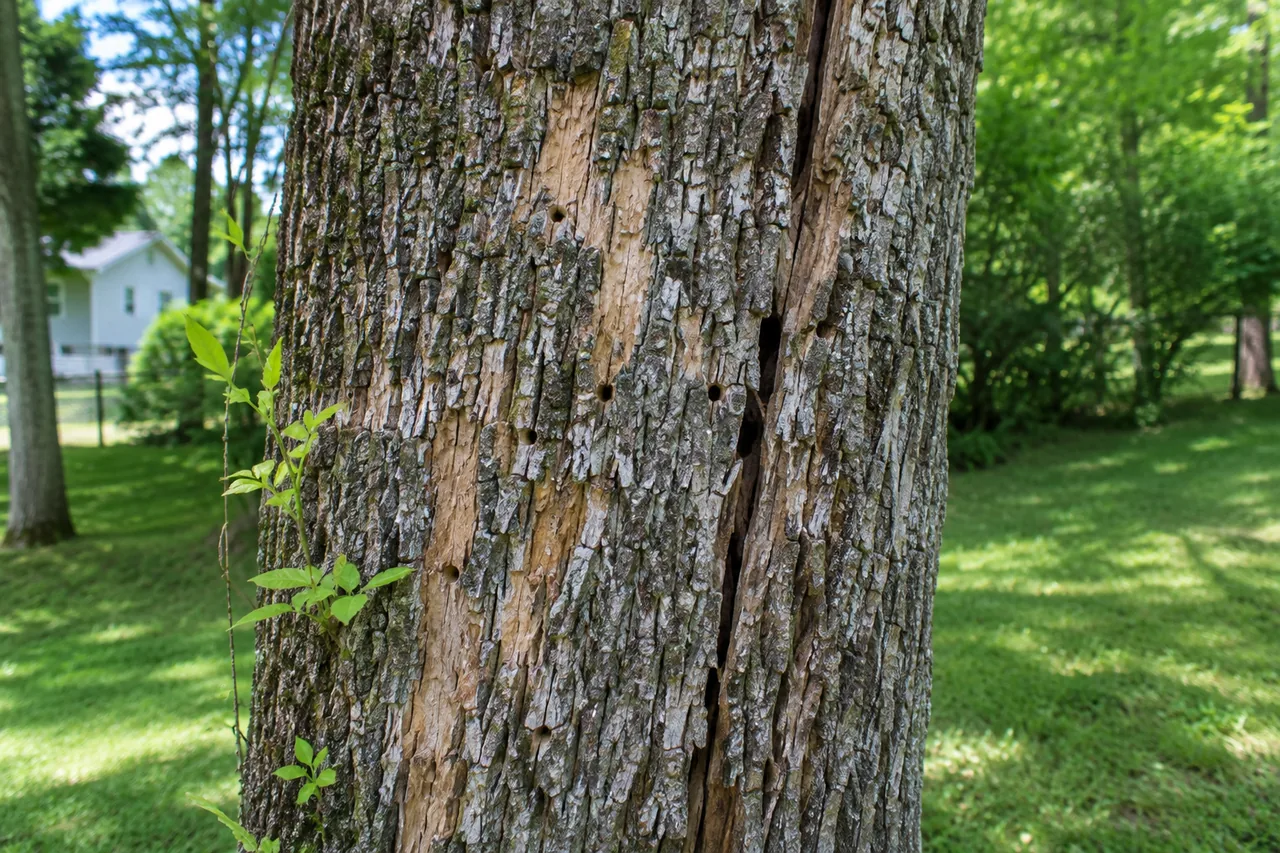
Maryland's forest service lists the signs (Maryland DNR):
- leaves thinning in the canopy, "usually starting at the tops and sides";
- woodpeckers stripping off bark and leaving lighter patches;
- "D" shaped exit holes, which "definitively indicate Emerald Ash Borer";
- "S" shaped tunnels under the bark;
- vertical cracks in the bark;
- sprouts around the base or along the branches.
Treat it or take it down?
A healthy, valuable ash with most of its crown can be protected with insecticide treatments, which have to be repeated. An ash already thin at the top, full of woodpecker marks, is usually past saving. The deciding issue near a house is time: ash killed by the borer dries out and becomes brittle, and the longer it stands dead, the harder and more expensive it is to take down safely, because climbing it is no longer an option. See tree removal.
What is killing the hemlocks?
The hemlock woolly adelgid, a tiny sap-feeding insect from Asia. West Virginia's 2025 forest health report lists it in all 55 counties. Look on the underside of the twigs for "masses of woolly white filaments ... at the base of the needles," Penn State Extension says. "Under the right conditions, HWA can kill eastern hemlock trees in as few as four years" (Penn State Extension, updated Nov. 24, 2021).
Unlike a dead ash, a yard hemlock can often be saved if it is caught early. Penn State describes systemic insecticides: an imidacloprid soil drench, which "typically lasts four to six years," and dinotefuran, which works faster and is often used on trees already in decline but protects for only one to two years. Follow the label, and check with your local Extension office. A hemlock with a bare, gray crown and few needles is past treatment and should come down before it drops limbs.
Why are the oaks dying?
Oak decline isn't one pest. It's several stresses piling up on old trees. West Virginia's 2025 forest health report says agriculture department staff received "numerous reports from landowners in the eastern panhandle areas of 'oak decline.'" On the sites they visited, they usually found red oaks infected with bacterial leaf scorch, or white and red oaks growing on very poor sites near the end of their productive lives. The report also describes whole hillsides of healthy oaks turning brown and dying (WV Forest Health Highlights 2025).
What part did spongy moth play?
Spongy moth caterpillars, once called gypsy moth, strip oak leaves in early summer. In 2025 the state counted 68,839 acres defoliated across Berkeley, Hampshire, Hardy, Mineral and Morgan counties. The same report describes a "collapse in the spongy moth population" in the Eastern Panhandle afterward, and says no properties had qualified for 2026 treatment, though more areas still needed surveying (WVDA spongy moth report, checked Nov 28, 2026). One stripping usually doesn't kill a healthy oak, but repeated defoliation on top of drought can.
Signs an oak is in trouble
- dead limbs high in the crown, and fewer, smaller leaves each year;
- red oak leaves browning along their edges in late summer, a sign of bacterial leaf scorch;
- mushrooms or shelf fungi at the base or on the roots;
- a cavity, a long crack, or bark falling off in sheets;
- roots cut by a new driveway, a trench or a foundation within the last few years.
A declining oak can stand for years, but its dead limbs come down in every storm, and a big oak trunk that fails onto a house makes for one of the hardest storm jobs a crew takes on.
What else is in the region?
- Beech leaf disease. Not confirmed in Berkeley County. A suspected find at Harpers Ferry, in Jefferson County, hadn't been confirmed in 2025 (WV Forest Health Highlights 2025).
- Spotted lanternfly. In Berkeley County since 2019. It weakens trees but mainly feeds on tree of heaven. See spotted lanternfly.
- Drought and root damage. Construction is the hidden one. A tree that lost roots to a new house may die years later.
When should you call about a dying tree?
Before it's fully dead, if it's within reach of something you care about. A tree that still has some life in it can usually be climbed and taken down in controlled pieces. Once it's dead and brittle, the same job may need a bucket truck or a crane. Late fall and winter are good times to look, with the leaves off and the dead limbs easy to see.
Common questions
Can I use the dead ash for firewood?
Yes, burned at home. Moving firewood long distances spreads pests, and forest agencies ask people to burn it near where it was cut.
Will a dying tree fall soon?
Nobody can give a date. What can be judged is how much of it is dead, whether the trunk or roots are decayed, and what it would hit.
Who do I report a new pest to?
The West Virginia Department of Agriculture, 304-558-2212 or bugbusters@wvda.us (WVDA).
Have a tree like this?
One independent local contractor who works the Martinsburg area can come out, look it over and put a price on it.
Call (681) 248-5434 Or write it up on the request form