
Tree work in Berkeley County
Stump Grinding in Martinsburg, WV
The short answer
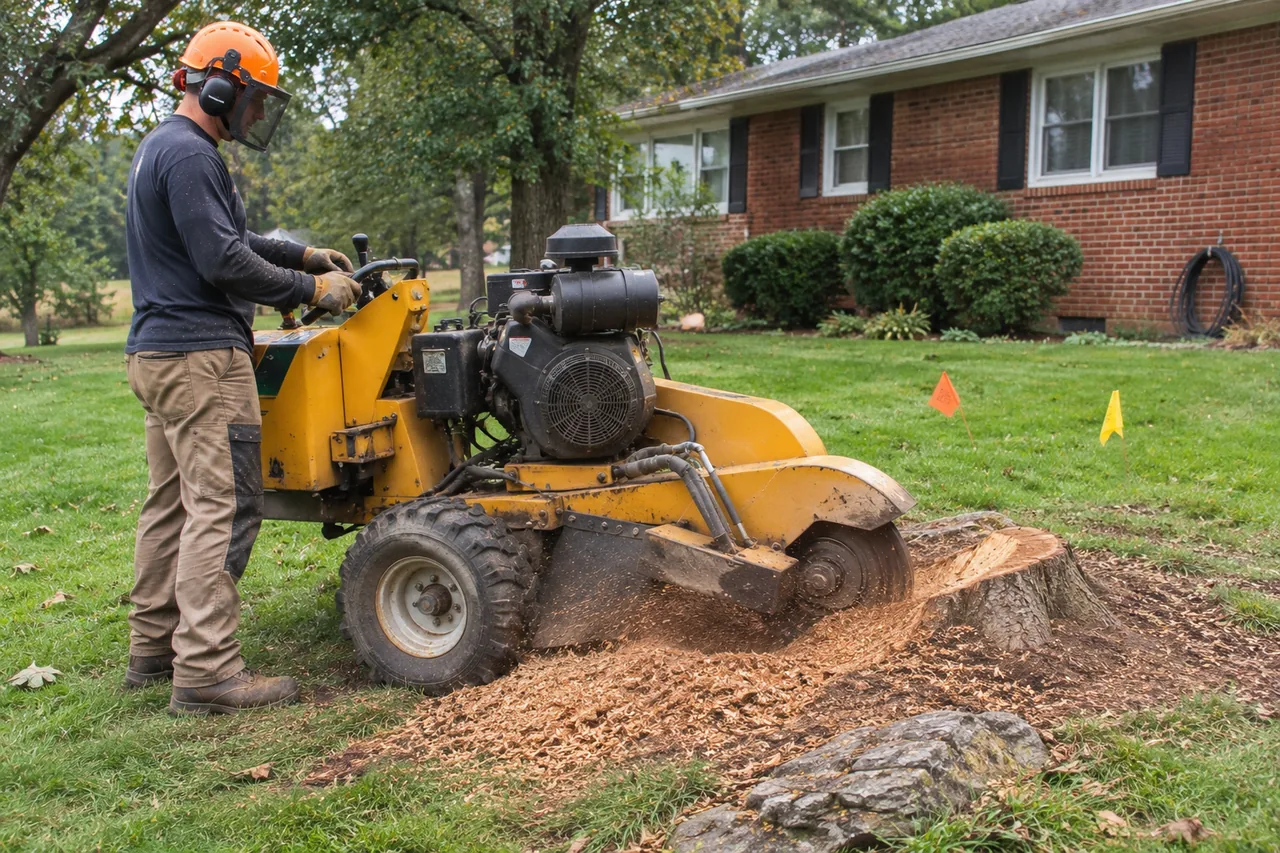
Stump grinding in Martinsburg starts with a WV811 ticket: West Virginia's one-call law requires notice at least 48 hours before excavation, not counting Saturdays, Sundays and legal holidays, and WV811 says a ticket is "Required by Law for ANY excavation." Grinding below the surface moves soil, so treat it as digging. One independent local contractor grinds the stump down, takes care of the 811 notice if the job calls for it, and prices it by the size of the stump.
HomeGuide's national figures run $2 to $6 per inch of diameter, or $120 to $400 for a first stump and $30 to $60 for each one after it (HomeGuide, undated, checked Nov 28, 2026).
What does West Virginia's 811 law require?
W. Va. Code §24C-1-5 requires an excavator to notify the one-call system "not less than forty-eight hours, excluding Saturdays, Sundays and federal or state legal holidays," and no more than ten work days before the work starts (W. Va. Code §24C-1-5, checked Nov 28, 2026). WV811's April 2026 presentation adds that the tolerance zone is 2 feet from the outside edge of a marked line, that the same rules apply to homeowners, and that WV811 itself "DOES NOT MARK THE LINES": each utility marks its own (WV811, April 8, 2026). The number is 811, or 1-800-245-4848.
One thing the slides don't settle: how long a ticket stays good. One slide says 10 days, not counting weekends and holidays; the law section quoted in the same deck says 15 business days. Ask WV811 if the job may run long.
Utility markers cover the lines the utilities own. Lines you own after the meter, like a power feed to a detached garage, a well line, a septic line or a gas line to a grill, may not be marked. Point them out to the contractor before grinding starts.
What happens when the grinder hits limestone?
Much of the valley floor around Martinsburg is limestone. USDA describes the Hagerstown series, a deep soil formed from limestone, as having hard limestone 40 to 84 inches or more below the surface (USDA, Hagerstown series, checked Nov 28, 2026). That's the depth to solid bedrock. In karst ground, ledges and pinnacles of rock can come up much closer to the surface than that, and old trees grow their roots around them. Grinder teeth that hit rock wear or break, so a stump wedged against an outcrop may be ground only to the top of the rock. Ask the contractor how deep the grind will go.
Shale ground behaves differently. USDA's shale soils such as the Berks series reach bedrock at 20 to 40 inches (USDA, Berks series), and shale breaks up into flat chips that a grinder can usually cut through, though roots there stay shallow and spread wide.
How deep does a stump get ground?
A common target is several inches below the soil surface, enough to cover with topsoil and seed. Planting a new tree in the same spot or laying a patio over it needs deeper grinding and removing the chips. Surface roots that run out across the lawn are separate work; HomeGuide says stump grinding usually excludes roots and prices root removal at $75 to $150 an hour.
The ground chips settle as they rot, so a ground stump area sinks a little over the following year. Topping it up with soil once is normal. In karst ground, a hollow that keeps sinking after that is worth a closer look: see karst and sinkholes.
Why does the stump keep sprouting?
Some trees resprout from their roots after they're cut. Tree of heaven is the worst around here: it's threat level 1, "highly invasive," on the state's invasive plant list (WVDNR, April 2025), and grinding the stump alone does not stop the suckers coming up across the yard. Black locust and Callery pear sprout too. Dealing with the root system, often with an herbicide treatment before the tree is cut, is covered on the tree of heaven page.
Grind it, dig it out or leave it?
| Choice | When it fits | What to know |
|---|---|---|
| Grind | Lawns, beds, most yards | Fast, little digging, roots stay and rot. Needs the 811 notice. |
| Dig out (excavator) | Footings, a driveway, a pool or a new building | Leaves a large hole to fill. Berkeley County's ordinance counts removing stumps and root systems as land disturbance. |
| Leave it | Wooded edges, fence lines | Rots over years. A tree of heaven or locust stump will sprout. |
| Cut flush | Mowing over it, low budget | The cheapest option, the stump is still there. |
The county's Subdivision and Land Development Ordinance (amended January 2025) defines "clearing" as cutting or removing trees without land disturbance, and puts removing stumps and root systems under "land disturbance." For one stump in a lawn that's a definition, not a permit. It starts to matter on bigger projects: the county asks for a site plan before more than 5,000 square feet are disturbed (Berkeley County Planning FAQs, checked Nov 28, 2026).
What does stump grinding cost?
| Item | Range |
|---|---|
| Per inch of diameter | $2 to $6 |
| First stump | $120 to $400 |
| Extra-large stump | $300 to $800 |
| Each additional stump | $30 to $60 |
| Minimum service charge | $80 to $160 |
| Root removal | $75 to $150 an hour |
Grinding done on the same visit as the removal often costs less than a separate trip. Rock, a tight gate and a stump on a slope push it up. The contractor's price after seeing the stump is the one that counts.
Common questions
Can I burn a stump?
Not inside Martinsburg: the city's burn rules exclude stumps and limbs over eight inches in diameter. State air rules for burning land-clearing debris set the same eight-inch limit before splitting. See burning brush.
What happens to the grindings?
They can be raked back into the hole, spread as mulch or hauled away. Say which before the job starts.
Can a stump be ground right next to the foundation?
Usually, with a smaller machine and care. Roots under the footing stay where they are.
Have a tree like this?
One independent local contractor who works the Martinsburg area can come out, look it over and put a price on it.
Call (681) 248-5434 Or write it up on the request form