
Eastern Panhandle trees
Spotted Lanternfly and Tree of Heaven in Martinsburg, WV
The short answer
West Virginia's first spotted lanternfly population was found in 2019 near Bunker Hill, in southern Berkeley County, and the insect's favorite host is the tree of heaven that grows along fence lines, roadsides and lot edges all over the county. Removing tree of heaven takes more than a chainsaw, because a cut tree sends up sprouts from its roots; one independent local contractor can take the trees down and plan how to keep them from coming back.
The West Virginia Department of Agriculture puts the first find near Bunker Hill in 2019, and WVU Extension says it was confirmed in Berkeley County in November 2019 (WVDA; WVU Extension, both checked Nov 28, 2026).
How far has the lanternfly spread?
By October 2021 the agriculture department counted four West Virginia counties with the pest: Berkeley, Jefferson, Mineral and Hampshire. It had spread west from eastern Pennsylvania since 2014, mostly by hitching rides on vehicles and goods (WVDA, Oct. 5, 2021). The state's 2025 forest health report lists it in 20 of the 55 counties (WV Forest Health Highlights 2025).
The agriculture department's pages read for this guide don't describe a West Virginia quarantine zone, and its lanternfly page points readers to a Pennsylvania map for the quarantined area (WVDA, checked Nov 28, 2026). Before moving logs, firewood, outdoor furniture or a camper out of the county, ask the department what rules apply where you're going: 304-558-2212 or bugbusters@wvda.us.
What does the lanternfly do to trees?
Nymphs and adults suck sap. WVU Extension says the feeding can eventually kill a plant left unmanaged, and the sugary honeydew they drop grows black sooty mold on whatever is below: decks, cars, patio furniture, the plants under the tree. Adults prefer tree of heaven, especially in late summer and fall, but the pest feeds on more than 70 kinds of trees and vines, including maple, walnut, grape, apple and cherry (WVDA).
What to do with the egg masses
The gray, putty-like egg masses show up on tree trunks, stone, vehicles, lawn furniture and other smooth surfaces, and the department notes they can be found in winter. Its advice: scrape them off, making sure to get the small dark eggs underneath, then double-bag them for the trash, burn them, or soak them in alcohol or hand sanitizer.
How do you recognize tree of heaven?
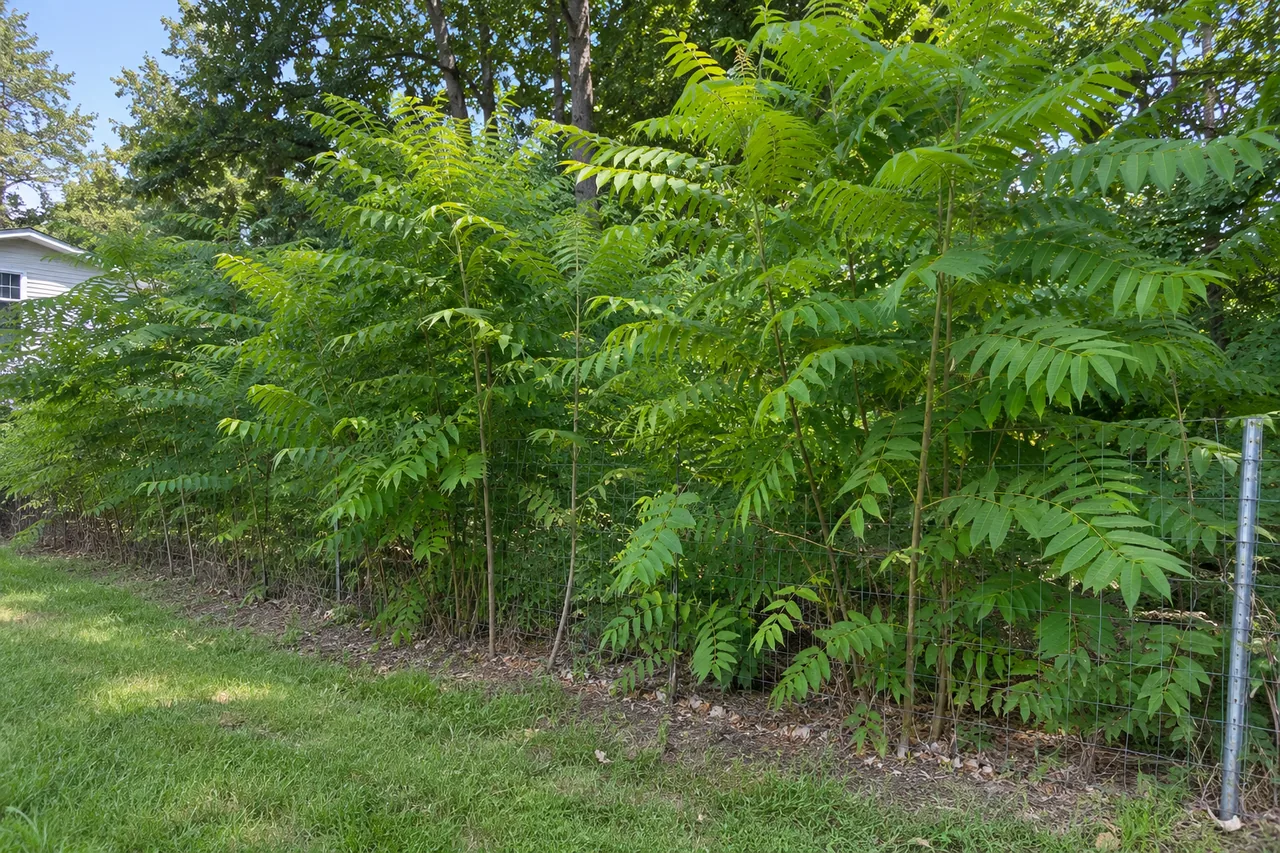
Tree of heaven (Ailanthus altissima) has long leaves made of many leaflets, each with one or two small bumps near its base, smooth gray bark, and a strong, unpleasant smell when a leaf or twig is crushed. It grows fast in poor ground, along fences, in alleys and at the edges of cleared lots. It is threat level 1, "highly invasive," on the West Virginia Division of Natural Resources' invasive plant list (WVDNR, April 2025), and Martinsburg's landscaping standards ban planting it in new developments (City Code §1307.12, Ord. 2022-13).
It's easy to confuse with black walnut, staghorn sumac and young hickories. Walnut leaflets are toothed along the whole edge and don't stink. If you're not sure, a close photo of a leaf and its base helps the contractor before the visit.
Why doesn't cutting it down work?
Tree of heaven spreads by roots. Cut the trunk, and the roots answer with sprouts, often many of them, some yards away from the stump. That's why a stand of them along a fence often gets thicker after someone cuts it. Penn State Extension says a cut tree responds "by producing large numbers of stump sprouts and root suckers," and that for a tree that has to come down, "it is best to treat with an herbicide first, wait for symptoms to develop (approximately 30 days), and then cut" (Penn State Extension, updated Nov. 2, 2020, checked Nov 28, 2026). Timing and products vary, and herbicide use has to follow the label. Ask the contractor how they plan to handle the roots, and whether a follow-up visit for sprouts is part of the price.
Female trees also make thousands of winged seeds. Taking out the big seed trees first slows the spread on your own lot.
What about Callery pear?
The other tree the state rates at threat level 1 is the Callery pear, sold for years as Bradford, Cleveland Select and other names. Planted pears cross with each other, and their seedlings come up as thorny thickets along roadsides and fields. Old Bradford pears grow tight, upright forks, the kind of fork that tends to split under wind or ice. A pear in the front yard that's starting to split is a removal, not a pruning job.
Which other invasive trees show up around Martinsburg?
| Tree | State ranking |
|---|---|
| Tree of heaven | Threat 1, highly invasive |
| Callery (Bradford) pear | Threat 1, highly invasive |
| Princess tree (paulownia) | Threat 1, highly invasive |
| Autumn olive | Threat 1, highly invasive |
| Norway maple | Threat 2, moderately invasive |
| Mimosa (silk tree) | Threat 2, moderately invasive |
| White mulberry | Threat 2, moderately invasive |
| Russian olive | Threat 3, occasionally invasive |
Common questions
Should I cut every tree of heaven on my lot?
Treat first and cut later, or the job grows. Small seedlings can be pulled when the ground is soft, roots and all.
Is the sap dangerous?
Many people find the sap irritating to skin. Wear gloves and long sleeves when handling cut tree of heaven.
Do lanternflies hurt people or pets?
They don't bite or sting. The trouble is the honeydew and mold, and the damage to grapes, orchards and trees.
Have a tree like this?
One independent local contractor who works the Martinsburg area can come out, look it over and put a price on it.
Call (681) 248-5434 Or write it up on the request form